


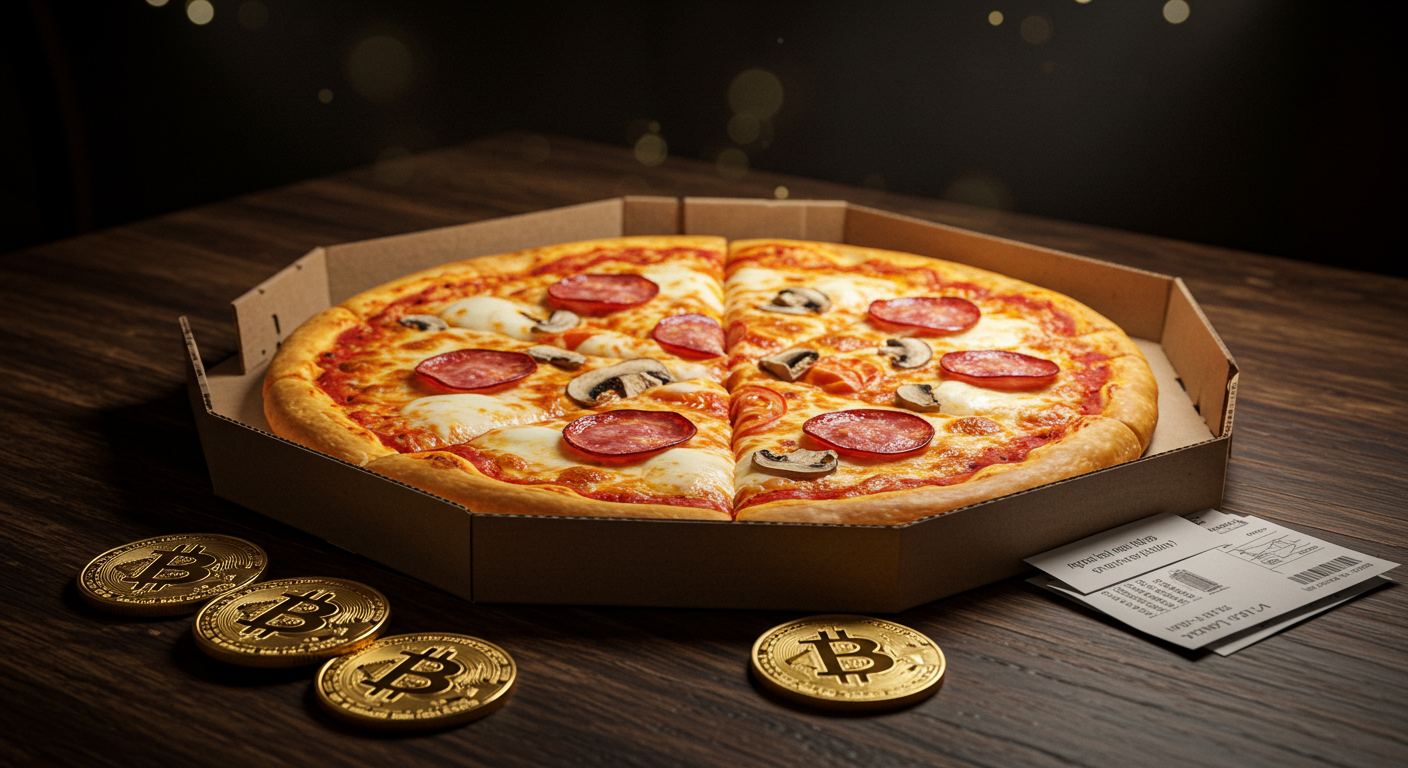
Imagine paying ₦6,271 for two pizzas… and finding out 15 years later it could’ve gotten you an exotic mansion in a location reserved for the 1%. On May 22, 2010, a man bought two pizzas with 10,000 Bitcoin. At the time, it didn’t seem like a big deal. Bitcoin was just an experiment—a new kind of money that most people didn’t understand. That simple pizza purchase became history. Today, the value of those 10,000 Bitcoins is ₦1.76 trillion. The day is now celebrated as Bitcoin Pizza Day, a yearly reminder of how far cryptocurrency has come. But what Bitcoin Pizza Day means isn’t just about money. It shows how quickly technology can shape our future, our finances.
For Nigerians, this day carries a deeper message. With inflation, limited jobs, and a weak Naira, many are searching for new financial hope. Some are turning to crypto—not just to survive, but to grow. Bitcoin Pizza Day shows how small bets on big ideas can lead to life-changing rewards. Knowing what Bitcoin Pizza Day means can inspire smart money choices.
This post talks about legendary Bitcoin transaction, and its lessons for Nigerians. You’ll see why this 15-year-old pizza story still matters today.
What Is Bitcoin Pizza Day?
Bitcoin Pizza Day marks one of the earliest and boldest moves in the world of cryptocurrency. Laszlo Hanyecz is the man who made the first real-world purchase using Bitcoin. He posted on a forum asking if anyone would order him two large pizzas in exchange for 10,000 BTC. Someone accepted the deal. Back then, those coins were worth just $41.
At the time, Bitcoin had no market value. It was mostly used by a small group of pseudonymous tech enthusiasts. But that pizza purchase showed that Bitcoin could be used like real money. It changed everything.
Bitcoin Pizza Day is more than a fun memory. It has become a symbol of crypto’s journey and how fast value can grow when people believe in something new. It goes beyond just pizza or price. It highlights human behavior around new technology. Most people didn’t take Bitcoin seriously in 2010. They didn’t see the future coming. But one man took a chance—and made history.
This day also reminds us that every big innovation starts small. It may seem useless or silly at first. But with time, ideas grow. And those who spot value early often benefit the most.
Whether you’re deep into crypto or just getting curious, this story shows how bold moves, even small ones, can spark global change.
Bitcoin Adoption in Nigeria
Nigeria is one of the top countries in the world when it comes to Bitcoin use. According to Chainalysis’ 2024 Global Crypto Adoption Index, Nigeria ranks second worldwide in grassroots crypto adoption, with approximately $59 billion in cryptocurrency value received between July 2023 and June 2024 . In fact, many young people now see it as a way to escape the weak Naira, rising inflation, and the plague unemployment.
But at the same time, many others are still afraid of Bitcoin. Some fear it’s a scam. Others worry about price crashes. And let’s not forget the past bans and warnings from the Nigerian government. These mixed signals have made people cautious—even when they see others making money from it.
This is where things get interesting. If we look at the big picture, Nigeria today is not so different from the world in 2010. Back then, most people ignored Bitcoin because they didn’t understand it. Only a few believed in it. Today in Nigeria, we’re living through our own version of that moment.
So, what Bitcoin Pizza Day means for us is a lesson in timing and mindset. While some people are playing it safe, others are exploring the future. The question is: will we learn from history, or repeat it?
We don’t all need to become crypto experts overnight. But we should at least pay attention. The risk of doing nothing might be greater than the risk of getting started.
Bitcoin Pizza Day teaches us that big opportunities often come quietly. And in Nigeria, that opportunity might already be here—we just have to see it.
Lessons From Bitcoin Pizza Day
Back in 2010, Bitcoin was just another tech experiment on a cypherpunk forum. No banks accepted it. No governments regulated it. And definitely, no Nigerian student was thinking of using it to pay for suya. To most people, it looked like an internet joke.
But here’s the kicker: So did mobile money. So did Jumia. So did Flutterwave.
In Nigeria, we’ve seen firsthand how innovations that once felt “too foreign” or “too risky” eventually reshape how we live. Bitcoin Pizza Day reminds us that the future often whispers before it shouts. The lesson here? Don’t ignore innovation because it seems small or risky.
Early adopters may look foolish, but they often win. Laszlo Hanyecz, the guy who bought the pizzas, isn’t bitter. He knew what he was doing — he wanted to prove Bitcoin could be used for real-world transactions. He became part of history.
Similarly, Nigerians who bought Bitcoin in 2015 or 2017 were laughed at. But some of them cashed out millions during the 2021 bull run.
Whether it’s crypto, AI, or a new startup idea, early adopters face criticism. But in the long game? They’re usually the ones smiling to the bank—or the blockchain.
Diversify: Don’t throw all your Naira into hype, but don’t ignore new systems either. Let’s be honest — not every innovation is a jackpot. Some tech trends fade. Others explode. That’s why balance is key. You don’t have to go “all in” on crypto. But ignoring it completely? That’s like refusing to learn how to use ATMs in 2002.
Use platforms like Binance or Quidax responsibly. Learn before you leap. Invest small, learn fast, and build a digital literacy mindset. Nigeria’s next wave of wealth may not come from oil—it could come from the blockchain, the cloud, or even code.
What If You Bought ₦5,000 Worth of Bitcoin in 2015?
Let’s take a real moment to imagine this:
It’s 2015. Bitcoin is trading at around ₦200 per dollar, and each BTC goes for just $250. You decide to risk it—out of curiosity or maybe boredom—and buy ₦5,000 worth of Bitcoin, which equals $25 back then.
With $25 in 2015, you’d have gotten 0.1 BTC.
Fast forward to 2025:
That 0.1 BTC is now worth $6,600 (as Bitcoin hovers around $66,000).
Lets assume today’s exchange rate is ₦1,500 per dollar, that’s over ₦9.9 million from just a ₦5,000 bet.
Year-by-Year Breakdown
| Year | BTC Price (USD) | Your ₦5K Value (USD) |
| 2015 | $250 | $25 |
| 2017 | $1,000 | $100 |
| 2020 | $9,000 | $900 |
| 2021 | $29,000 | $2,900 |
| 2023 | $30,000 | $3,000 |
| 2025 | $66,000 | $6,600 |
So, What Does This Teach Us?
This isn’t about regret. It’s about vision. The truth is, you probably had ₦5,000 to spare in 2015. What you didn’t have was belief. And that’s the same thing stopping many Nigerians from exploring Bitcoin, DeFi, Web3, or even AI opportunities today.
The real lesson behind Bitcoin Pizza Day isn’t thatff someone lost out on billions—it’s that most people sleep on innovation until it’s too late.
There’s always a “₦5K moment” in every tech wave—an opportunity that looks small and silly until it’s not. In 2015, it was Bitcoin. In 2025, it might be something else.
Bitcoin, Regulation, and the Nigerian Youth
In Nigeria today, there’s a quiet tug-of-war happening beneath the surface of everyday tech conversations. On one end is the Central Bank of Nigeria (CBN), tasked with stabilizing the nation’s economy and protecting its financial system. On the other end? Millions of young Nigerians, digitally literate, globally connected, and increasingly crypto-curious.
This tension came to a head in 2021 when the CBN issued a directive banning financial institutions from facilitating cryptocurrency transactions. To some, it looked like a full-on attack on digital freedom. To others, it was a protective measure in a volatile economic landscape. Either way, it sparked a movement that hasn’t slowed down—if anything, it intensified crypto adoption underground.
The Ban That Backfired
Ironically, the CBN’s ban didn’t kill Bitcoin in Nigeria—it only pushed it deeper into the informal economy. Peer-to-peer (P2P) exchanges surged. Crypto Telegram groups multiplied. Young Nigerians—especially developers, freelancers, and traders—continued to use Stablecoins like USDT to receive international payments, bypass inflation, and hedge against the Naira’s decline.
Nigeria has since ranked consistently among the top 5 countries globally in crypto usage, according to Chainalysis and Paxful reports. It’s not just about speculation; it’s survival. For a 22-year-old graphics designer in Kaduna, Bitcoin isn’t some Wall Street asset—it’s how she gets paid by a client in Canada without losing value to inflation or bank delays.
The Rise of Crypto Literacy
Crypto literacy is growing, and it’s youth-led. Tech Twitter, university campuses, YouTube channels, and grassroots communities like Web3Ladies, Binance Campus Ambassadors, and the Stakeholders in Blockchain Association of Nigeria (SiBAN) are pushing education at scale.
Nigerian youth are no longer asking “What is Bitcoin?” They’re asking:
- “How do I store my keys safely?”
- “Which wallet is best for multi-chain assets?”
- “Can I build a DAO or deploy a smart contract as a Nigerian dev?”
This shift in conversation is what makes this moment so powerful—and so threatening to traditional power structures.
Read Also: Blockchain and Crypto Explained for Beginners
eNaira vs Bitcoin: The Battle for the Future
The CBN’s answer to the crypto wave came in the form of the eNaira, Nigeria’s official Central Bank Digital Currency (CBDC). Launched in October 2021, the eNaira was meant to modernize Nigeria’s payment infrastructure, deepen financial inclusion, and offer a government-backed digital alternative.
But the thing is: Nigerian youth aren’t buying it.
Why? Because the eNaira is everything crypto is trying to escape—centralized, monitored, and limited in function. It doesn’t offer freedom or borderless access. It doesn’t solve inflation. And most importantly, it doesn’t empower the user—it still empowers the system.
Meanwhile, decentralized cryptocurrencies like Bitcoin offer:
- Control over your own money
- Borderless, frictionless transactions
- Privacy and autonomy
- Protection against Naira devaluation
This doesn’t mean decentralized finance is perfect. Far from it. There are scams, technical risks, and a steep learning curve. But for many Nigerian youth, the trade-off is worth it.
So, What’s Next?
The Nigerian government has a choice to make: criminalize innovation or collaborate with it. If regulators truly want to protect consumers, they must shift from restriction to regulation—clear rules, local exchanges with accountability, and education over enforcement.
For Nigerian youth, the goal isn’t rebellion. It is relevance. They want to be part of a global economy. They want digital access, not digital silence. And they’re not waiting for permission.
The young Nigerians learning about Bitcoin today aren’t just speculating—they’re building the foundation of Africa’s digital economy.
And whether regulators like it or not, the future is already being written—on the blockchain.
5 Small Steps to Join the Future Without Regret
Let’s say you’re curious, but still cautious. That’s smart. Here are five simple ways to start engaging with crypto and emerging tech—no hype, no pressure:
- Download a crypto wallet like Trust Wallet and explore its features. You don’t have to buy anything—just get familiar.
- Follow credible Nigerian voices in crypto like Rume Ophi (The Crypto Preacher), Adedeji Owonibi, Senator Ihenyen, Osaretin Victor Asemota, Aisha Said Umar, Chris Ani, Eberechukwu Agbapuonwu (Web3Ladies), just to mention a few.
- Use ₦1,000 to test P2P on a platform like Binance, just to understand how it works (not financial advice—just education).
- Read 1 blog per week about Web3, Bitcoin, or DeFi. Start with CoinDesk, Cointelegraph or Giditech.net.
- Join a free online course like Binance Academy or Crypto Bootcamp.
If you were Laszlo today, what would you do? Would you laugh off crypto like a joke—or take time to understand it? Would you dismiss blockchain as hype—or explore how it could change your business or your future? Drop a comment.
Frequently Asked Questions (FAQ)
What is Bitcoin Pizza Day?
It marks the first real Bitcoin purchase—two pizzas bought for 10,000 BTC on May 22, 2010. It’s now a symbol of crypto’s growth.
Why does it matter to Nigerians?
It shows how tech that seems small can change lives. With inflation and limited jobs, crypto offers Nigerians new financial paths.
How much is 10,000 BTC worth now?
Over ₦1.76 trillion as of 2025—proof of how early belief in innovation can pay off.
Is it too late to invest in Bitcoin?
No, but start small and learn first. The crypto space still holds many opportunities beyond just Bitcoin.
Is Bitcoin legal in Nigeria?
Banks can’t handle crypto, but peer-to-peer (P2P) trading is allowed and popular.
How is Bitcoin different from the eNaira?
Bitcoin is global and decentralized. The eNaira is controlled by the government. Many youth prefer Bitcoin for its freedom.
How can I safely start with crypto?
Download a wallet, try small P2P trades on Binance, follow trusted voices, and take free online courses.
Can I earn from crypto without trading?
Yes—through freelance work, holding crypto, airdrops, or teaching about Web3.
What is a “₦5K moment”?
It’s a small decision—like spending ₦5,000 on Bitcoin in 2015—that could lead to massive returns later.
Can crypto fight poverty in Nigeria?
Yes. It helps people save in stable currencies, receive global payments, and build digital careers.

4 Comments
Your blog is a constant source of inspiration for me. Your passion for your subject matter is palpable, and it’s clear that you pour your heart and soul into every post. Keep up the incredible work!
Great article.💯
Awesome! Its genuinely remarkable post, I have got much clear idea regarding from this post
Thị trường nhà cái uy tín đổi thưởng ngày càng bùng nổ với vô số lựa chọn, nhưng liệu đâu là nền tảng thực sự đáng tin cậy? Nhiều người chơi đã phải học bài học đắt giá khi tham gia các nhà cái thiếu minh bạch: tiền thắng không thể rút, tài khoản bị khóa vô cớ, hay tỷ lệ trả thưởng không công bằng. Hãy cùng khám phá slot365 – một lựa chọn đang được đánh giá cao bởi cộng đồng người chơi nhờ tính minh bạch, bảo mật và đa dạng trò chơi. TONY06-05