



Getting hired in the Web3 space isn’t as easy as influencers make it appear online. The harsh truth many tend to shy away from is, the months of silence that follows your application could mean that your resume has been ignored. If you’re wondering how to write a resume for Web3 jobs, you’re not alone and most people are doing it wrong. In fact, up to 90% of resumes submitted for Web3 roles never make it past the first glance. They’re too generic, too technical, or worse, a copy-paste from Web2 templates that miss the language, and style of the decentralized world.
Web3 hiring managers don’t want a list of duties. They want to see that you understand what it means to work in an ecosystem built on transparency, autonomy, and community. It doesn’t matter if you are applying as a writer, a developer, a community manager, a product lead, or a DAO contributor. Your resume needs to prove more than your skills. It needs to prove you are fit.
By the end of this article, you’ll know how to write a resume for Web3 jobs that gets read, gets remembered, and gets results even if you’re just getting started in the space.
See Also: How to Build a Portfolio for Web3 Roles Without Prior Experience
What Happens After You Hit Submit
Most recruiters in Web3 are drowning in applications, sometimes hundreds for a single role. Your application has seconds to make an impression. That’s why understanding what happens after you hit submit is key to learning how to write a resume for Web3 jobs that actually gets read.
It’s not just about beating bots (though that matters). It’s about getting past human filters, the founder skimming on their phone at midnight, the contributor checking a spreadsheet during a governance call, the recruiter looking for proof you belong in this world.
If your resume looks like a LinkedIn export, or worse, like it was written by someone who’s never touched crypto, it’s gone.
Why Most Applicants Fail (And It’s Not Just About Experience)
A lot of people applying for Web3 roles, who end up getting rejected, are actually qualified. Ironic much?. They’ve built projects, contributed to DAOs or grown communities. But their resumes don’t show it. Some even bury it under buzzwords and bullet points. So what gives?
Most applicants fail not because they lack skills, but because they lack context. They list “project management” when they mean “shipped three protocol upgrades with cross-functional teams across three time zones,” and write “marketing experience” when they could’ve said “grew a DeFi project’s Twitter from 5k to 50k using memes, threads, and token-gated AMAs.”
Web3 is still new. There’s no single way to format a resume and that’s what makes it risky. If your resume reads like it was copied from a Web2 playbook, it suggests you don’t fully get how things work here. The best resumes hit the point within seconds. So if you’re trying to figure out how to write a resume for Web3 jobs, the first step is understanding that you’re not just listing experience. You’re framing it in a way that shows you belong.
What Recruiters in Web3 Really Want
Forget job titles for a second. Web3 recruiters aren’t just looking for “community managers” or “smart contract devs.” They’re looking for proof: can this person contribute meaningfully and fast in a decentralized, often chaotic environment?
That means they care less about your polished resume format and more about these three things:
1. Proof of Execution
Whether it’s code, content, products, or playbooks, they want to see what you’ve actually done, not just what you were responsible for. In Web3, execution beats experience.
2. Understanding of the Ecosystem
You don’t need to be a crypto native, but if your resume mentions zero DAOs, tokens, governance, protocols, or Web3-native tools, it might show you’re not ready yet. Even non-technical roles require cultural fluency.
3. Adaptability and Autonomy
Web3 organizations move quickly. Roles shift. Priorities change. Recruiters look for people who can handle ambiguity, work async, and take initiative without needing constant direction.
That’s why, when you’re thinking about how to write a resume for Web3 jobs, you can’t just copy a traditional format and hope for the best. Your resume needs to answer an unspoken question: “Would I trust this person to jump into a Telegram thread and solve real problems next week?”
Top Mistakes That Cost You the Interview
Your resume might be smart, clean, and packed with experience and still get skipped. Why? Because in Web3, how you present matters just as much as what you present. Here are the most common mistakes that quietly kill your chances:
1. Web2 Language in a Web3 World
Writing things like “stakeholder alignment” or “enterprise-grade solutions” may sound professional, but in Web3, it feels out of touch. Use words that reflect how the space actually works. Think protocol, DAO, airdrop strategy, L2 scaling, community incentives, etc.
2. Overloaded with Jargon
On the flip side, don’t write like a crypto whitepaper. If your resume is packed with obscure terms or maxed-out technical complexity, you risk confusing the person reading it. Remember that clarity = credibility.
3. No Proof of Work
Saying “I worked on a DeFi product” means little without links, GitHub, writing samples, dashboards, or community metrics. In Web3, if you did something cool, show it.
4. One Resume for Every Role
A general resume for every job = a resume that fits no job. Web3 roles are niche. Tailor your application for the protocol, product, or community you’re applying to.
These missteps are easy to fix once you see them. And doing so makes a huge difference especially when competition is global and fast.
How to Write a Resume for Web3 Jobs (Step-by-Step Guide)
Most people ask how to write a resume for Web3 jobs but start with the wrong question. It’s not about which template to use. It’s about how to tell a story that proves you belong in the space.
Here’s a step-by-step breakdown that works
Step 1: Start with a Sharp Summary
Your summary is your elevator pitch so make it count. In 2–3 lines, explain:
- Who you are (briefly)
- What you’ve done that’s relevant to Web3
- What kind of role or contribution you’re looking for
Example:
“Community strategist with 3+ years scaling online ecosystems. Helped grow an NFT project from mint to 50k members. Passionate about governance design, onboarding, and helping DAOs scale sustainably.”
Step 2: Highlight Relevant Projects (Not Just Job Titles)
Web3 is project-first. If you’ve contributed to a DAO, bounty, hackathon, or side project, lead with that, not just full-time roles.
Include:
- What you did
- What changed because of it (impact)
- Links to proof (GitHub, Mirror, X, dashboards, Notion, etc.)
Tip: Format like mini case studies:
Project Name | Role | Dates
1–2 sentences on scope
1–2 bullet points on outcomes or impact
Step 3: Showcase Your Web3 Fluency
Weave in vocabulary and signals that show you “get it.” Mention:
- Tools (Snapshot, Gnosis, Discourse, Etherscan, etc.)
- Protocols or communities you’ve engaged with
- Experience with async collaboration, multisig wallets, or tokenomics
Even if you’re applying for marketing or ops, fluency matters.
Step 4: Quantify Outcomes
Numbers stand out. Always tie your work to a measurable result:
- “Increased Discord engagement by 60% in 3 months”
- “Decreased smart contract audit time by 40%”
- “Coordinated governance proposals with 80%+ approval rates”
No metrics? Mention scale, reach, or timeline.
Step 5: Keep Formatting Clean, Scannable, and Modern
Recruiters aren’t reading. They’re skimming. Use:
- Clear headers (Summary, Projects, Experience, Skills)
- No dense paragraphs
- 2–3 bullet points per section
- No unnecessary logos, tables, or fancy design
Stick to PDF unless a protocol specifically asks for something else.
Step 6: End with Skills, Tools & Links
Wrap up with a skills section but keep it relevant:
- Hard skills (Solidity, analytics, governance frameworks)
- Soft skills (async comms, DAO coordination)
- Tools (Notion, Dune, Farcaster, etc.)
Include links to GitHub, Mirror/Blog, twitter (if active) and a personal site or portfolio
What a Great Web3 Resume Might Look Like
Let’s bring everything together with a fictional example. Below is a simplified template of a strong Web3 resume. One that gets a second look.
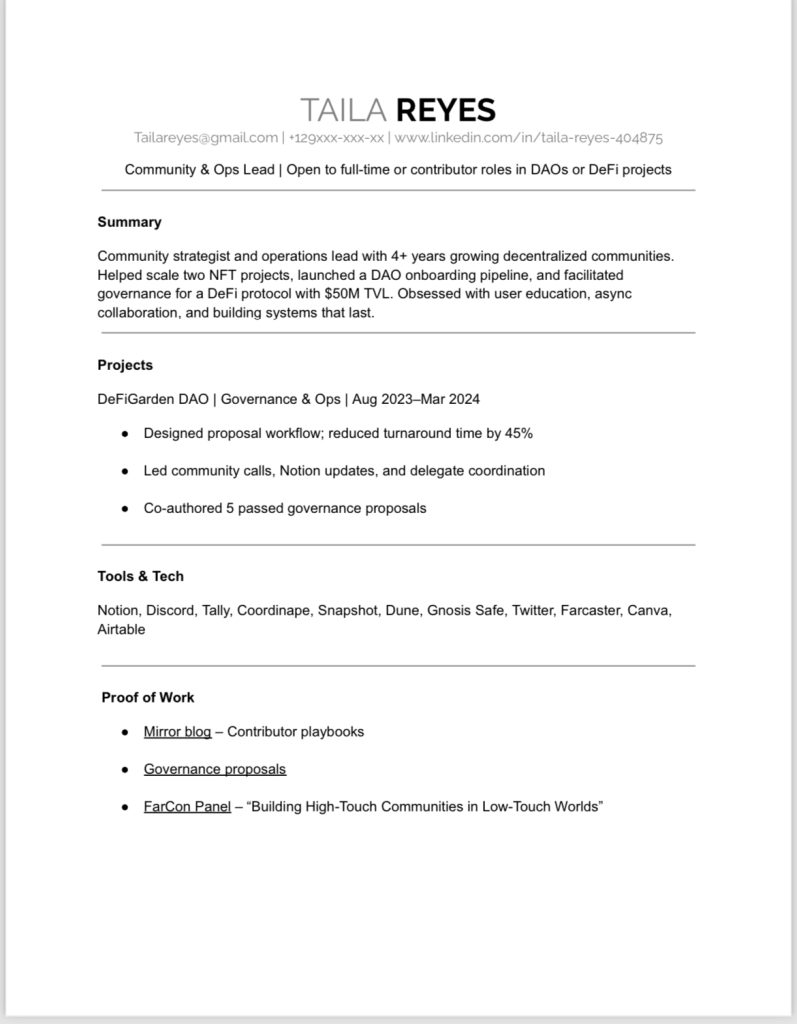
Why It Works
- Proof of work is baked into every section (with links!).
- Context shows she understands Web3 culture.
- Clarity in formatting and impact metrics.
- Tone balances professionalism with personality.
This format works because it answers the core question: “Can this person contribute in Web3 today?”
How to Show Proof of Work (Even if You’re New)
So you’re not a dev. You haven’t shipped a protocol. You don’t have a massive following. Can you still show proof of work in Web3? Absolutely! And it might matter more than you think. In Web3, “proof of work” isn’t just a consensus mechanism. It’s about showing that you’ve already started contributing, learning, or building, even before you get hired.
Here’s how to demonstrate value, even if you’re early:
1. Create Public Work
Write a short explainer on something you’ve learned (e.g. “How Optimism Governance Works” or “What is MEV?”). Publish it on Mirror, Paragraph, or your own site. Post summaries or threads on Twitter to signal your interest publicly.
2. Join a DAO or Community
- Even passive participation counts:
- Attend a call, vote in a proposal, or contribute to forum discussions.
- Screenshot your engagement and link to it.
Add it to your resume as:
DAO Contributor (Part-time) | Oct 2024–Present
Participated in community calls, submitted proposals, and contributed to onboarding resources.
3. Solve a Problem without Permission
If you see a protocol with a messy Notion, poor onboarding flow, or outdated docs? Fix it. Redesign the Notion. Suggest improvements. Write a clearer guide. Then share the before/after or tag the team with your proposed solution. Even if it doesn’t get accepted, it shows initiative and that stands out.
4. Build a Portfolio of Curiosity
Make a “Proof of Work” section on your resume or site. Include:
- Articles
- Forum posts
- Github repos (even if incomplete)
- Mock campaigns or community ideas
- Workshop notes or slide decks
Remember that in Web3, your resume is only part of the story. The rest is what you leave online that is visible, searchable, and verifiable.
Using Keywords to Beat Resume Filters
Even in decentralized ecosystems, your resume still goes through filters. Whether it’s an ATS (Applicant Tracking System) or just someone scanning a Notion doc, keywords determine visibility. If you want your application to be found, matched, and read, you have to speak the language of the space. But that doesn’t mean stuffing your resume with every buzzword in crypto. It means using clear, relevant, high-signal terms that align with the role.
Where Keywords Matter Most:
- Your summary
- Headlines and role titles
- Bullet points under projects or jobs
- Skills/Tools section
- Linked URLs and filenames (yes, really)
What Kind of Keywords Should You Include?
- If you are a developer, consider keywords like Solidity, smart contracts, EVM, zk-rollups, L2s, audits, gas optimization, Hardhat, Foundry, GitHub, dApps
- For Non-Devs, Governance, DAOs, tokenomics, incentive design, content strategy, onboarding, community growth, async collaboration, airdrops, bounty programs
- For tools, use words like Snapshot, Gnosis Safe, Notion, Discourse, Coordinape, Dune, Mirror, Farcaster, Subgraph, Airtable
Bonus tip: Look at the job description and mirror the exact phrases used. If it says “DAO coordination,” don’t write “community facilitation” . Match the language.
Avoid These Common Mistakes:
- Keyword dumping (listing 50 tools you’ve barely used)
- Using generic terms like “technology” or “marketing” with no Web3 context
- Copying irrelevant keywords just because they’re trending
If you’re serious about learning how to write a resume for Web3 jobs, mastering keywords is essential. Done right, they make your resume easier to find and easier to understand.
Time-Saving Tools to Build Your Resume
Writing a resume for Web3 jobs can feel overwhelming. But you don’t have to start from scratch. There are tools purpose-built to help you write smarter, format cleaner, and even build proof of work along the way.
Here are some time-saving favorites:
1. Standard Resume
A clean, distraction-free resume builder that’s especially great for Web3 and startup-style CVs.
- Auto-formats as you go
- Supports multiple versions
- Easy PDF and web exports
2. Notion + Fruition or Super
Create a live resume or portfolio on Notion and turn it into a sleek, custom site. Perfect for showcasing DAO contributions, writing, or a community roadmap.
3. Resume Worded
Provides AI-powered feedback on clarity, impact, and keyword usage, ideal for refining your resume for recruiter eyes.
4. Mirror, Paragraph, or Typedream
Want to show proof of work? These platforms help you publish articles, tutorials, proposals, and Web3 essays that double as resume assets.
- Use them to create a content portfolio
- Link directly from your resume
Bonus Tools:
- Grammarly – for typos, tone, and clarity
- Canva Resume Templates – for clean, design-forward resumes
- GitHub Pages or Replit – if you’re a dev who wants a simple, hosted resume
The key isn’t finding the “perfect” tool. It’s using the one that helps you stay consistent and confident. When in doubt, start simple and build as you go.
Where to Apply for Web3 Jobs (And What to Expect)
You’ve got your resume. You’ve got some proof of work. Now, where do you actually apply? Web3 hiring is less structured than traditional tech. Some roles are listed publicly, others are shared in Discords, and many are filled through referrals, community engagement, or cold DMs.
Here’s where to start looking and what to expect once you do:
Top Platforms to Find Web3 Roles
1. Crypto Jobs List
One of the longest-running Web3 job boards. Roles range from DeFi to NFTs to layer 1s.
2. Work in Crypto
Search by role type, pay range, or remote-only gigs.
3. Web3 Jobs
Browse by protocol, chain, or category (e.g., DevRel, DAO Ops, Product).
4. Reverent
A newer platform focusing on contributor-first matching. Think: DAO bounties, part-time contributor roles, and more fluid opportunities.
5. Crypto Twitter and Discord
A huge % of jobs are shared informally. Follow teams you admire, join community calls, and keep an eye on threads with hiring announcements. These platforms are noisy but often where the best roles surface first.
What to Expect After You Apply
- Speed varies. Some teams respond in 48 hours, others take weeks.
- Hiring may be async. Expect interviews over Telegram, Discord, or Google Meet.
- You might be asked to contribute first. Some DAOs want to see a week or two of async trial work. Treat it like a live audition.
- Ghosting happens but don’t take it personally. Keep showing proof of work.
In Web3, applying once and waiting doesn’t cut it. The people who get hired are the ones who stay visible, helpful, and intentional. That’s why your resume is only one tool and your presence is the rest.
FAQs
Q1: Do I need Web3 experience to apply for a Web3 job?
No, but you need to show curiosity and a willingness to learn. Reframe your past experience using Web3-relevant language and demonstrate that you’re already engaging with the space.
Q2: Should I use a standard resume template or build a custom site?
Either works as long as it’s scannable, clean, and link-friendly. Bonus points if you can show live proof of work via Notion, Mirror, or GitHub.
Q3: How long should my Web3 resume be?
1 page is ideal. 2 pages max, only if you have dense, high-value experience or project breakdowns.
Q4: Should I apply through job boards or cold outreach?
Both. Many roles are filled through informal networks, so showing up in a Discord, replying to a tweet, or sending a thoughtful DM can be just as powerful.
Q5: Can I use ChatGPT to help write my resume?
Yes, but don’t rely on it completely. Use it to brainstorm, rephrase, or optimize. Then layer in your voice and edit for clarity and culture.

4 Comments
This is value expressed.
Thank you Taiye!
I’ve learned more from this post than anywhere else.
I’m glad you find it helpful.