


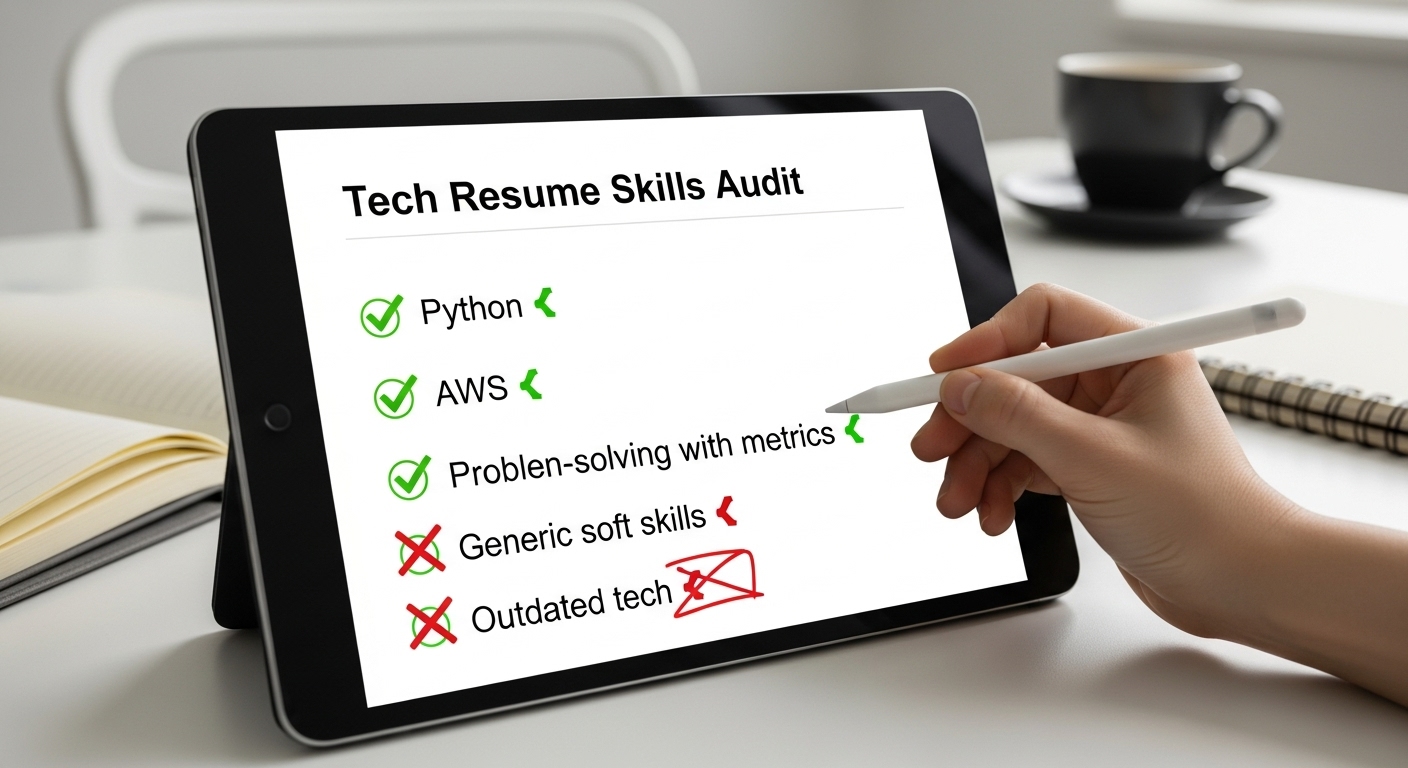
Your resume has 30 seconds of a recruiter’s attention. Maybe less if they’re on their fourth coffee and hundredth application of the day. Even more interesting, recruiters also rely heavily on Applicant Tracking Systems (ATS) that scan for skills, keywords, and experience. That means your resume isn’t just a summary of what you’ve done. It’s your professional story told in a way that matches what employers are actively searching for. Hence, it must contain the career skillset for a tech resume.
I’ve seen resumes that list “Python, JavaScript, AWS, Machine Learning” but say nothing about what the person built with those tools. I’ve also seen candidates with half those skills land interviews. Why? They showed exactly how they used Git to save a team from a deployment disaster, or how their API optimization cut server costs by 40%.
Contrary to what most people think, you don’t have to list every experience you have or tool you’ve touched. It’s about strategically combining hard skills (like coding) with soft skills (like problem-solving or communication) in a way that tells a compelling story about your capabilities. And of course, gets you invited to the interview that lands you the job.
So what skills should your tech resume highlight? How should you tailor them for each job application? This blog breaks it down.
See Also: How to create a tech resume that beats AI filters
Why Your Tech Resume Needs the Right Career Skillset
Let’s talk about what changed. Five years ago, you could land a tech job by listing your degree, your years of experience, and maybe throwing in “proficient in Java” somewhere near the top. Recruiters cared about where you worked and how long you stayed there. That playbook is doesn’t cut it anymore. Now? 65% of hiring managers will hire you based on skills alone. No degree required, no five-year tenure at a brand-name company necessary. They want proof you can do the work, and they want it front and center on your resume. This shift to skills-based hiring isn’t some trendy HR buzzword. It’s now how companies are actually filling roles because they’ve figured out that someone who can demonstrate they’ve built scalable APIs matters more than someone who has “Senior Developer” on their LinkedIn for three years but can’t explain their code.
But here’s where it gets tricky. Your resume isn’t being read by a person first. It’s being fed into an Applicant Tracking System that’s scanning for specific keywords and skill matches. These systems are getting smarter and more widely used. The ATS market is projected to keep growing through 2029. This means your carefully crafted career skillset for a tech resume needs to speak two languages: robot and human.
And the competition? It’s brutal in a weird way. The IT sector is booming with a 35% hiring outlook. And it sounds great until you realize that means hundreds of other qualified candidates are applying to the same role you want.
What most people miss is that the right skills on your resume aren’t just about getting past the ATS filter. They’re about making the hiring manager think, “This person won’t need three months of hand-holding to contribute.” They’re looking at your resume and mentally calculating how quickly you’ll solve their problems. Not how impressive your background looks on paper.
See Also: How to write a resume for web3 jobs
Core Technical Skills Every Tech Resume Needs
Here’s the part where most resume guides tell you to “list your technical skills” and call it a day. That advice isn’t very instrumental. What actually matters is knowing which technical skills make a recruiter lean forward in their chair versus which ones just fill space.
1. Programming Languages That Actually Open Doors
Python, JavaScript, and Java aren’t just popular—they’re the languages companies are actively hiring for because they power most of the applications being built today. But listing “Python” on your resume means nothing if you can’t show what you built with it. Companies increased their SaaS tool usage by 76% in the last year, which means they need developers who don’t just know syntax but can actually build and integrate software that solves business problems.
Don’t write “Proficient in Python.” Write “Built automated data pipeline in Python that reduced manual reporting time from 6 hours to 20 minutes.” See the difference? One is a claim. The other is proof.
2. Cloud Computing Isn’t Optional Anymore
Over 90% of companies use cloud services daily. If your resume doesn’t mention AWS, Azure, or Google Cloud Platform, you’re signaling that you’re stuck in 2015 when everything lived on physical servers.
What separates a decent cloud mention from one that gets you interviewed are the specifics. “Experience with AWS” is weak. “Migrated legacy monolithic application to AWS microservices architecture, reducing infrastructure costs by 30% and improving deployment speed by 5x” shows you understand cloud isn’t just about storage—it’s about solving actual business problems.
Multi-cloud experience is becoming increasingly valuable too. Companies don’t want to be locked into one provider. So if you’ve worked across platforms, that’s worth highlighting in your tech resume skills.
3. Data Skills Are Non-Negotiable
Every tech role now expects some level of data literacy. You don’t need to be a data scientist, but you should be able to write SQL queries. You also need to understand how to extract insights from datasets, and maybe work with Python libraries like Pandas or visualization tools like Tableau.
Why? Because data-driven decision making is how companies operate now. A backend engineer who can analyze API performance metrics is more valuable than one who just writes code and hopes it works. A frontend developer who can interpret user behavior data and adjust the UI accordingly is worth more than someone who only makes things look pretty.
And AI and machine learning skills? They’re rapidly moving from “nice to have” to “expected.” You don’t need a PhD in machine learning, but understanding how to work with AI APIs, implement basic models, or at least speak intelligently about how AI could improve a product makes you significantly more hireable. Multiple sectors are desperate for people with even foundational AI knowledge.
4. Cybersecurity Basics (Yes, Even If You’re Not in Security)
Cybersecurity jobs are projected to grow 32% through 2032, with 3.5 million positions going unfilled in 2025. What that stat really means for your resume is that every company is paranoid about security breaches, which means every developer needs to think about security.
Even if you’re applying for a frontend role, mentioning that you understand authentication, encryption basics, or secure coding practices signals that you won’t accidentally create a vulnerability that gets the company hacked. If you have certifications like Security+ or CEH, even better—but practical experience (“Implemented OAuth 2.0 authentication and resolved 12 security vulnerabilities identified in code review”) carries more weight.
5. Version Control and Collaboration Tools
If you’re not listing Git or GitHub on your resume, hiring managers assume you’ve been working in isolation or haven’t touched modern development workflows. Version control isn’t a bonus skill—it’s baseline.
Same goes for Agile methodology and project management tools like Jira or Trello. Companies work in sprints, track tasks digitally, and expect you to collaborate asynchronously. Not mentioning these tools in your career skillset for a tech resume is like a chef not mentioning they know how to use knives.
Show evidence: “Managed sprint planning and code reviews for 8-person development team using Git workflows and Jira” tells the story better than “Familiar with Agile.”
The pattern here is clear enough. Technical skills matter, but context matters more. Your ATS-friendly tech resume should list these skills clearly in a dedicated section for the robots. Then, prove you actually used them in your experience section for the humans making hiring decisions.
See Also: Skills-based hiring trends and Online tech courses
The Soft Skills That Actually Matter
Let’s address the elephant in the room: soft skills sections on tech resumes are usually garbage. Everyone writes “excellent communication skills” and “strong team player” like it means something. It doesn’t. Hiring managers have seen those exact phrases on literally thousands of resumes.
So what changed? Employers are now hiring for culture fit as much as technical ability. This means the soft skills in your career skillset for tech resume need to be real. It must be provable, and directly tied to outcomes. Not aspirational personality traits you think sound good.
1. Communication That Translates Tech to English
The most valuable developers I know aren’t the ones who write the most elegant code. They’re the ones who can explain what their code does to someone in marketing without making them feel stupid. If you can translate complex technical concepts into language your non-technical stakeholders actually understand, you’re worth more than three developers who can’t.
This shows up in your career skillset for tech resume not by writing “strong communicator” but by demonstrating it: “Led weekly sprint reviews for 15-person cross-functional team, translating technical blockers into business impact for product and marketing stakeholders.” That sentence tells me you can code and explain why the timeline just shifted.
Written communication matters even more in remote and distributed teams. Can you write clear documentation? Can you explain a bug in a Slack message without needing three follow-up calls? Companies are desperate for people who communicate clearly in writing because most developers… don’t.
2. Problem-Solving Beyond Stack Overflow
Every developer can Google error messages and copy solutions from Stack Overflow. What separates candidates in a competitive market is the ability to solve problems that don’t have a neat answer in the first three search results.
This is about showing you can think through a problem systematically, try different approaches when the first one fails, and actually fix things instead of just escalating them. Hiring managers want to see evidence of this in your tech resume skills. “Debugged critical production issue affecting 10,000+ users by analyzing server logs and identifying race condition in payment processing queue—resolved within 3 hours with zero data loss.”
That’s problem-solving. That’s what gets you hired.
3. Adaptability and Continuous Learning
Tech changes fast enough that whatever framework is hot today might be legacy code in three years. Companies know this, which means they’re looking for people who can learn new tools quickly without needing formal training every time.
Candidates who show continuing education and professional development demonstrate they’re not going to become dead weight when the tech stack evolves. This is a crucial part of your career skillset for tech resume because it signals long-term value.
List recent courses, bootcamps, or certifications—but make them relevant. “Completed Advanced React Hooks course (2025)” is better than “Completed 47 Udemy courses” because one shows focused learning and the other suggests you collect certificates without applying them.
Showcasing commitment to continuous learning genuinely sets candidates apart. It’s the difference between someone who learned Java in 2018 and stopped, versus someone who’s actively keeping up with Java’s evolution and experimenting with new features.
4. Remote Work Competencies (Because Most Jobs Are Hybrid Now)
Self-motivation, time management, and async collaboration aren’t just buzzwords—they’re what make or break remote employees. If you’ve successfully worked remotely, that’s worth mentioning because companies are terrified of hiring someone who needs constant supervision.
Show it with specifics: “Maintained 98% on-time delivery rate while working remotely across 3 time zones, coordinating with distributed team through async standups and detailed documentation.” That proves you can work independently without someone watching over your shoulder.
The pattern with soft skills is that they only matter on your career skillset for tech resume if you can prove them with outcomes. Otherwise, delete them and use that space for literally anything else.
How to Showcase Your Career Skillset Effectively
You can have every skill a company wants and still get rejected if you present them wrong. Here’s how to actually showcase your career skillset for tech resume in a way that gets both the ATS and the human recruiter on your side.
1. Strategic Placement Matters More Than You Think
Your professional summary at the top of your resume has one job: make someone want to keep reading. This should be a 2-4 line introduction that positions your technical focus and key strengths without sounding like a generic template.
Bad: “Experienced software developer seeking new opportunities to leverage my skills.”
Better: “Full-stack engineer with 4 years building scalable APIs for fintech applications. Reduced transaction processing time by 60% through database optimization and improved team deployment frequency from monthly to weekly through CI/CD implementation.”
See the difference? The second one immediately tells me what you do, where you do it, and that you’ve solved real problems. Your career skillset for tech resume should be crystal clear within those first few lines.
2. Using Metrics to Prove Impact
Numbers cut through the noise faster than anything else. “Increased system efficiency by 25%” or “reduced server response time from 3 seconds to 800ms” makes it infinitely easier for recruiters to assess your value at a glance.
Every bullet point in your experience section should follow this pattern when possible: [Action Verb] + [Skill/Technology] + [Measurable Result].
“Refactored legacy Python codebase, improving test coverage from 40% to 85% and reducing bug reports by 60%” checks all the boxes. It shows the technical skill (Python, testing), the action (refactoring), and the impact (fewer bugs).
Before and after comparisons work especially well: “Migrated data pipeline from manual processing (6 hours daily) to automated Python scripts (15 minutes daily), freeing up 30 hours per week for analytics work.” That’s a story a hiring manager can visualize.If you don’t have exact numbers, estimate conservatively. “Approximately 40% reduction” is better than no metric at all.
The Right Format for you
Reverse-chronological format is still the gold standard for tech resumes. It’s familiar to recruiters, easy for ATS systems to parse, and clearly shows your career progression. Functional or hybrid formats might seem creative, but they usually just confuse the parsing systems. They make recruiters wonder what you’re trying to hide.
Keep your design clean and minimalist. White space is your friend. Dense paragraphs of text make people’s eyes glaze over. Use bullet points for your experience, but keep each bullet to 1-2 lines maximum.
ATS-compatible templates matter. Fancy graphics, tables, text boxes, and headers/footers often break when the ATS tries to read them. Stick to standard fonts (Arial, Calibri, Georgia), standard section headings (Work Experience, Education, Skills). And save your resume as a .docx or PDF depending on what the application requests.
Include your LinkedIn URL and portfolio/GitHub link in your header. If a recruiter is interested in your career skillset for tech resume, they’re going to look you up anyway. Just make it easy for them. Just make sure your LinkedIn actually matches your resume. Inconsistencies raise red flags.
FAQs: Career Skillset for Tech Resume
Q: How many skills should I list on my tech resume?
Enough to prove you’re qualified, but not so many that it looks like you’re padding. Aim for 10-15 core technical skills in your dedicated skills section. Make sure you include the ones you could actually use in a project tomorrow without needing a tutorial. If you’re listing 30+ skills, recruiters assume you’re either lying or you know each one at a surface level. And that won’t help them. Quality over quantity. Always.
Q: Should I include skills I’m still learning on my tech resume?
Only if you’re honest about your proficiency level. Writing “Python (intermediate)” or “Currently learning React” is fine—it shows you’re actively upskilling. But don’t list something you touched once in a weekend tutorial. If you can’t answer technical questions about it in an interview, it doesn’t belong on your career skillset for tech resume. You will get caught, and it’s embarrassing for everyone.
Q: Do soft skills matter on tech resumes?
They matter, but only if you prove them with specific examples. Generic phrases like “excellent team player” get ignored because everyone writes them. But “Mentored 3 junior developers through code reviews, reducing their average PR revision cycles from 4 to 1.5” shows leadership and communication. Soft skills belong in your experience bullets with concrete outcomes, not in a random list at the bottom.
Q: Should I list outdated technologies on my tech resume?
Only if they’re relevant to the job you’re applying for. If a company explicitly needs someone with legacy system experience in COBOL or older Java versions, mention it. Otherwise, listing technologies that haven’t been industry-standard since 2010 makes you look out of touch. Replace them with current skills or remove them entirely. Your resume should reflect where the industry is now, not where it was when you started your career.
Q: How do I show skills without professional experience?
Focus on projects, bootcamps, freelance work, or open-source contributions. “Built full-stack e-commerce site using React and Node.js with Stripe payment integration (personal project, 2025)” is legitimate experience even if no one paid you for it. Transitioning candidates often have transferable skills too—if you managed projects in your previous career, that’s relevant for tech project management or Agile roles. Just make sure the technical skills are front and center since that’s what companies are hiring for.
Q: How often should I update my skills on my resume?
Every time you learn something new that’s job-market relevant, and every time you apply for a role. At minimum, review your skills quarterly to remove anything that’s become obsolete and add new technologies you’ve picked up. The tech industry moves fast. A resume that hasn’t been updated in a year looks stale, and a career skillset for tech resume from 2023 might already be missing critical 2025 expectations like AI tool familiarity or current cloud platforms.
Q: What’s the difference between hard skills and soft skills on a tech resume?
Hard skills are the technical, measurable. For example, Python, AWS, Git, SQL. Soft skills are the interpersonal and cognitive abilities such as communication, problem-solving, adaptability. Both matter, but they serve different purposes. Hard skills get you past the ATS and prove you can do the technical work. Soft skills, when demonstrated with real examples, show you can work effectively with a team. Never list soft skills without proving them through your experience.

9 Comments
Great visuals and clear captions — they added a lot of value.
Thank you Armando.
This is my first time pay a quick visit at here and i am really happy to read everthing at one place
Normally I do not read article on blogs however I would like to say that this writeup very forced me to try and do so Your writing style has been amazed me Thanks quite great post
There is definately a lot to find out about this subject. I like all the points you made
Your blog is a constant source of inspiration for me. Your passion for your subject matter is palpable, and it’s clear that you pour your heart and soul into every post. Keep up the incredible work!
Your blog is a treasure trove of valuable insights and thought-provoking commentary. Your dedication to your craft is evident in every word you write. Keep up the fantastic work!
Pingback: How to Use Remote OK For Jobs in Nigeria - Giditech
Pingback: Dollar-Earning Platforms for Nigerians Beyond Upwork - Giditech